7v7 Rules
Click here for our 7 V7 Flag Football Rules. For questions on our rules, please see one of our directors on game day. N ZONE SPORTS RESERVES THE RIGHT TO MODIFY RULES DURING THE SEASON WHEN, AS NEEDED, AND AS SEEN FIT FOR THE SAFETY AND/OR INTEGRITY OF TH
Published on 10/06/2026
Flag Football Rules (7v7)
GENERAL
- Team rosters can consist of approximately 10-14 players and is based on seasonal participation per age bracket.
- Teams will play 7v7 games throughout the season.
- Player rosters will be checked throughout the season, if needed.
- Roster additions/changes/switches will not be made after week 2. Any revisions to a roster can only be made/approved by a N Zone Sports Manager, Director, or Owner.
- Any player who does not actively participate in regular season games or practices, may NOT participate in playoff/championship games. Participants must participate in at least 4 regular season games in order to be eligible to participate in Finals.
- Ball Size: Ages 11+, Junior.
- Field Length: 75x50
- N Zone Sports reserves the right to ask the player’s parents/guardians to produce valid proof of age in the form of a birth certificate or other forms of legal identification.
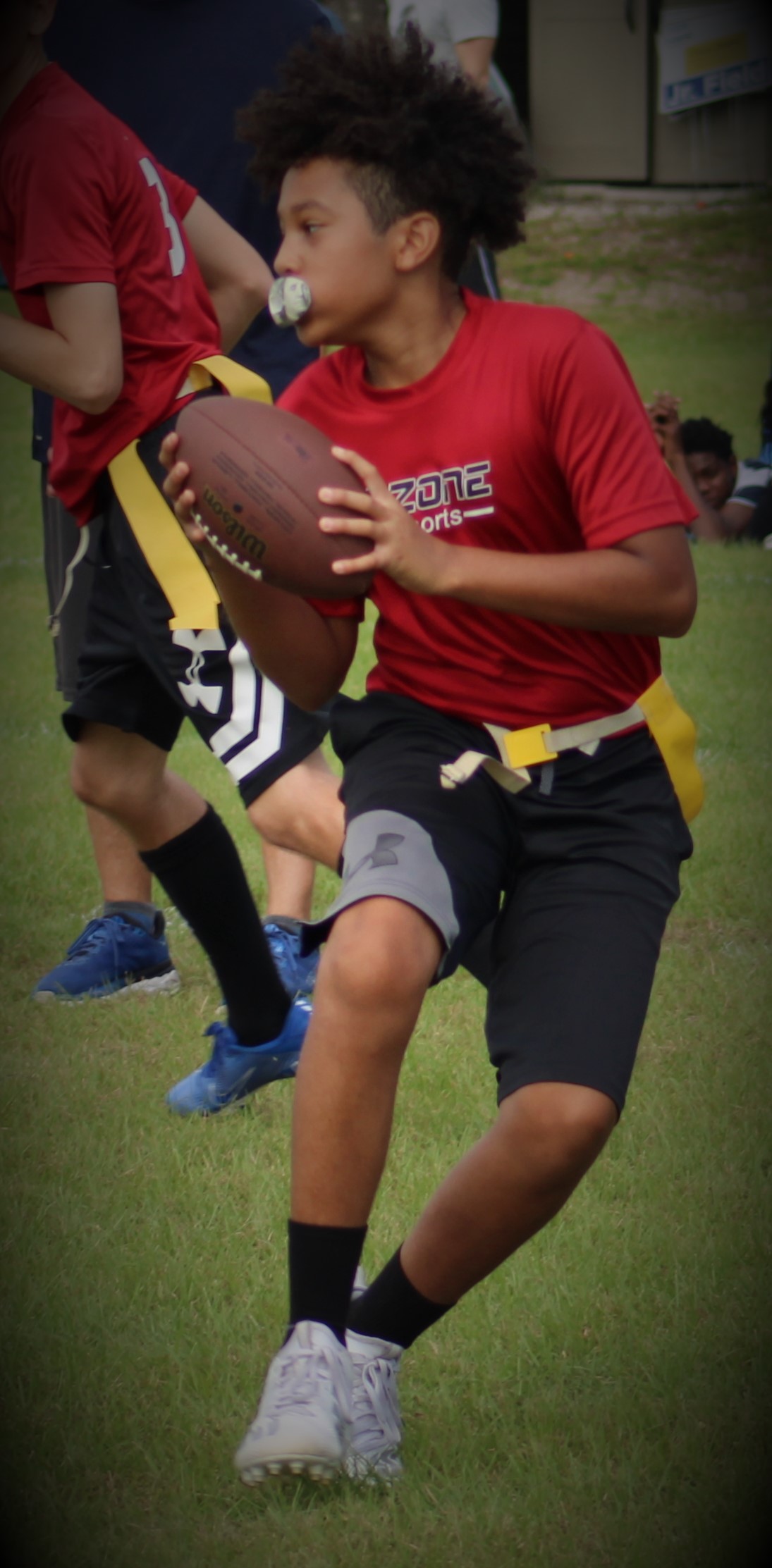
- Only N Zone Sports issued flag belts can be used during games, which are described as follows: White belts with attached yellow flags, and red, yellow, blue, or green clasps. (clasp color determines belt size)
GAME RULES
- 7v7 Games: Maximum players on field, 7. Teams must always field a minimum of 6 players. Games will be played and are official if a team can field the minimum within 10 minutes after the scheduled start time. Game official will start the clock. If a team cannot field at least 6 of its players, the team forfeits, and a 6-0 score will be recorded. No exception. Note: While a “minimum” rule exists, the opposing team with enough players must consent to play down to the minimum number of players. Otherwise, they may choose to field the max number of players of 7.
Options:
- If a team only has 7 players, they can request to play 6v6 so they can have a sub but the opposing team (as long as they have more than 7 players) must agree. If they do not agree then they game will be played as 7v7. If both teams can only field 7 players each then they both can opt to play 6v6 but most teams must agree. If they cannot agree then the game will be played as 7v7.
- Cannot force a team whose players show up, to play down.
ATTIRE
- Cleats are required. Non-metal, spiked cleats are not allowed. Inspections will be made, if needed.
- All players must wear a protective mouthpiece, no exceptions.
- N Zone Sports will supply each player with an Official Game Jersey. Jerseys must be worn and tucked in, during play. No jeans, no pockets, no jewelry, and no hats with lids will be allowed on the field during play.
- Players cannot wear yellow shorts.
COACHES/SIDELINES
- Only 1 coach is permitted on the field or in the huddle. Once a play begins, the coach must step back and not interfere. This includes pushing/pulling players at the beginning of or during a play. Coaches will be asked by Game Official to step-off of the field if there is any indication of interference.
- Only 2 coaches are allowed on the sidelines per team, per game. Exception: Student Volunteers. Coaches may have up to 2 student volunteers earning Bright Future Hours.
- There will be 1 sideline designated for Coaches and Players of the scheduled games only. Other coaches, other team players, siblings, parents, etc. are NOT allowed on this sideline. No exceptions.
- For hot weather or rainy days, 1 tent per team is allowed on the Coach & Player sideline only.
FOREITURE RULES
- A forfeit can only be officially called once it is approved by a N Zone Sports Manager, Director, or Owner.
- Teams have 10 minutes from the start of a scheduled game to field the minimum number of players or they must accept a forfeit. Only the Game Official can “start the clock”.
- Coaches or Officials cannot forfeit a game on their own terms, for any reason. If all players are present, the game must be played. Non-compliance of this rule by any coach or official may result in immediate termination of position at N Zone Sports Southshore, whether paid staff or volunteer.
NOTE: If a game gets “chippy” or extremely heated at any point:
- Game Official(s) will call an immediate timeout.
- During timeout, coaches will pull their team together to talk about sportsmanship and the N Zone Sports Character Values we promote. Team parents should also be included.
- Game Official will immediately notify Authorized N Zone Sports Representative/Director/Owner of any situation that may jeopardize the integrity of this league, which is intended to be fun & recreational for all participants, coaches, officials, and families.
GAME OFFICIALS
- One official will be provided for each game.
Optional: During Playoff & Championship Games, 2 Game Officials may be provided IF AVAILABLE.
- Game Officials should avoid interfering with the course of play but are considered part of the field.
- Game Officials will briefly explain all rule infractions to the offending player.
PROCEDURES
- A coin toss by Game Official determines first possession. The visiting team will call the toss. The winner of the toss will either accept the ball and begin on offense or elect to go on defense. Whichever team plays defense to begin the game will have the ball on offense to begin the 2nd half.
- An offensive team takes possession of the ball at its 5-yard line and has 3 plays to cross midfield. Once a team crosses midfield, it has a set of 3 new downs to score a touchdown. If the offense fails to score, the ball changes possession and the opposing team takes control of the ball on its own 5-yard line. (Any time a team turns a ball over on downs, regardless of where they are on the field, the opposing team begins their drive at their own 5-yard line.)
- Each time the ball is spotted, a team has 30 seconds to snap the ball. Teams will receive 1 warning before a delay-of-game penalty is enforced.
- Each team receives 2 timeouts per half.
- The clock is a running clock throughout the game but will stop in the 2nd half on a change of possession.
- In the last 2 minutes of the 2nd half, only timeouts, changes of possession, incomplete passes, and injuries or official timeouts can stop the clock.
- The ball is spotted where the runner’s front foot is when the flag is pulled, not the position of the ball.
- Fields will be clearly marked with painted lines, pylons, and discs.
Note: There are no kickoffs, no punts and no blocking allowed.
SCORING
- Touchdown: 6 points
- Extra point: 1 point (played from 5-yard line no-run zone) or 2 points (played from 12-yard line)
Note: Interceptions cannot be returned on extra-point attempts.
TIMING/OVERTIME
- Games are 40 minutes (2 x 20 minutes halves) with a running clock.
- Halftime is approximately 5 minutes long.
- If the score is tied at the end of 40 minutes, teams move directly into overtime with a coin toss for possession. Overtime format is Texas Shootout with the ball placed at the 12-yard line. Each team will have 3 downs to score. If successful, a team may opt for a 1 or 2 point conversion.
- If the game is still tied after 1 overtime period the 2nd team to have possession in OT1 will receive the ball first and each team will have 1 play to produce the most net yards from scrimmage from the 12-yard line (heading towards the goal). If the ball carrier's flag is pulled in the backfield, the loss of yardage will be noted. If both teams score on their possession in OT2, proceed to OT3, etc. No extra points are to be attempted in OT2 and beyond.
- Each team has 1 time out in overtime.
- Each time the ball is spotted, a team has 30 seconds to snap the ball. Teams will receive 1 warning before a delay-of-game penalty is enforced.
- As noted previously, in the last 2 minutes of the 2nd half only timeouts, changes of possession, incomplete passes, and injuries or official timeouts can stop the clock.
- Game Officials can stop the clock, if needed.
- Inside the last 2 minutes of the 2nd half, if a TD is scored the clock will stop. An untimed PAT will be attempted. The clock will resume upon the snap of the next offensive play.
- If a touchdown is scored as time expires, a 1 or 2 point try will ensue. However, if the score takes place at the conclusion of a game (2nd half), the extra point attempt will only be done if the result of the try has an implication on the outcome of the game. No exceptions.
PASSING
- The quarterback is defined as the person that receives the snap.
- The quarterback has a seven-second “pass clock.” If a pass is not thrown within the seven seconds, the play is ruled dead. Once the ball is handed off, the seven-second rule no longer is in effect (i.e. running QB)
- If the seven-second clock expires while the quarterback still has the ball, the play is blown dead, a down is lost and the ball is returned to the line of scrimmage as if an incomplete pass occurred.
- All passes, except for screen passes, must be forward passes; i.e. thrown from behind the LOS and received beyond the LOS.
- A screen, or backward pass, is allowed and is defined as a pass that is thrown behind the LOS and is thrown to a WR who is at a point behind the QB. With a screen pass, the WR can throw or run the ball. If the pass does not go behind the QB and is still behind the LOS then it will be considered a forward pass/extended handoff and the WR must run, not pass.
- The QB can throw the ball away to avoid a sack but the ball must go beyond the LOS and in the vicinity of a receiver…QB cannot spike the ball unless it travels beyond the LOS and lands near a teammate.
- Shovel passes, forward pitches are allowed and are essentially a forward pass or extended handoff. No backwards pitches.
- Any player who has received a legal handoff can throw the ball forward as long as the runner is behind the LOS and the pass is thrown beyond the LOS.
- Centers are not eligible to receive a direct handoff.
- When receiving a pass, the center must be at least one yard beyond the line of scrimmage.
- Interceptions change the possession of the ball and are the only changes of possession that do not start on the 5-yard line. Interceptions are allowed and can be run back. Completion of an interception is NOT a dead ball, except on an extra point attempt.
RUNNING WITH THE BALL
- Quarterback sneaks or runs are not permitted.
- The quarterback is defined as the person that receives the snap.
- Direct handoffs, pitches, and shovel passes behind the line of scrimmage are permitted and considered a forward pass or extended handoff. Handoffs may be in front, behind or to the side of the offensive player but must take place behind the line of scrimmage. The offense may use multiple handoffs.
- No backwards pitches
- A player who takes a legal handoff may elect to pass if he/she has not yet crossed the line of scrimmage. The player may also hand the ball off, i.e. reverse, as long as the exchange occurs behind the LOS.
- A “Center Sneak” play is not allowed
- If the ball hits the ground on a snap it is a dead ball and is to be placed where it hit the ground.
- “No-run zones” are located 5 yards from each end zone.
- Diving (leaving your feet) is not allowed by any offensive player except when attempting to catch a pass.
- Runners may leave their feet if there is a clear indication that he/she has done so to avoid collision with another player without a flag guarding penalty enforced. This will be up to the discretion of the referee.
- Spinning is allowed, but players cannot dive or leave their feet to advance the ball or avoid their flag being pulled. Players spinning out of control will be called for flag guarding
- The ball must be snapped between the legs of the center and clearly change possession to the QB. The ball cannot be handed directly back to the center in sideways fashion.
- IF the center is capable, the center may snap the ball at an angle or to one side or the other and the player who takes the snap/possession is the QB. The snap does not have to go directly behind the center or directly to the player behind the QB.
- The ball is spotted where the flag was when pulled. The ball is not spotted at the forward most point of progress of the ball, but rather at the spot of the most forward foot.
- i.e. The ball is spotted where the runner’s front foot is when the flag is pulled, not the position of the ball.
- Offensive players without the ball must stop their motion once the ball runner has crossed the line of scrimmage. There is no running with the ball-carrier.
- Wide Receivers may not set up blocks/picks/screens downfield for ball carriers.
- Once the ball has been handed off in front, behind or to the side of the quarterback, all defensive players are eligible to rush.
RECEIVING
- All players are eligible to receive passes, including the center.
- The center must be at least one yard (3 ft) beyond the LOS
- A player must have at least one foot inbounds with complete control of the ball when making a reception.
- Receivers can leave their feet to catch a pass.
- In the event of simultaneous possession during a reception by both an offensive and defensive player, possession is awarded to the offense.
- A receiver’s route cannot be cut off or blocked by a defensive player; no jamming a WR. However, a rusher maintaining a direct line to the quarterback has the right of way.
- Once the ball crosses the line of scrimmage, there can be no offensive exchanges of possession. Ex: No hook and laterals or down field handoffs.
- Wide Receivers may not set up blocks/picks downfield for ball carriers or interfere with the rusher/blitzer…they must stop running once the RB crosses the LOS or a reception is made so as not to interfere in anyway with the defense’s attempt to pull the runners flag.
- The play is blown dead immediately if an interception is made on an extra-point try. There are no returns on that play
DEAD BALLS
- The ball must be snapped between the legs (direct or shotgun), not off to one side, to start play.
- Substitutions can be made at the beginning of a new possession or after any dead ball.
- Play is ruled “dead” when:
- Ball carrier’s flag is pulled.
- Ball carrier steps out of bounds.
- Touchdown or safety is scored.
- Ball carrier’s knee hits the ground.
- Ball carrier’s is touched with one hand after flag falls off.
- The Game Official blows the whistle.
NOTE: There are no fumbles. If a ball is fumbled, it is the offense’s ball at the spot the ball hits the ground. If fumbled forward the ball is spotted where the ball came loose.
DEFENSE - RUSHING THE QUARTERBACK
- All players who rush the passer must be a minimum of seven yards from the line of scrimmage when the ball is snapped. Officials will mark the 7 yard rush point with a cone.
- A special marker identified as the blitz cone, or the referee, will designate seven yards from the line of scrimmage.
- Any number of players can rush the quarterback as long as they are on or behind the blitz cone; i.e. no part of a player’s foot can be in front of the blitz cone.
- Teams are not required to identify their rusher before the play
- Teams are not required to rush the quarterback
- Players not rushing the quarterback may defend as far forward as the line of scrimmage.
- Once the ball is handed off, the seven-yard rule no longer is in effect, and all defenders may cross the line of scrimmage. This also applies for backwards passes and pitches.
- Blitzers/Rushers are allowed a direct, clear path to the QB. Offensive players are not allowed to impede the rusher in any way; i.e. no pick plays, blocking, and WR’s are not allowed to interfere in the route of the rusher.
- The rusher has the right to a clear path to the quarterback, regardless of where he or she lines up prior to the snap. If the “path or line” is occupied by a moving offensive player, then it is the offense’s responsibility to avoid the rusher. Any disruption to the rusher’s path and/or contact will result in an impeding the rusher penalty. If the offensive player does not move after the snap, then it is the rusher’s responsibility to go around the offensive player and to avoid contact
- A sack occurs if the quarterback’s flag is pulled behind the line of scrimmage. The ball is placed where the quarterback’s front foot was when flag was pulled
- A safety is awarded if the sack takes place in the offensive team’s end zone
- A safety is awarded if the snap is fumbled in the offensive team’s end zone
- Defenders are not allowed to “Jam” a wide receiver at the line of scrimmage or physically alter the receiver’s route.
- Defenders are allowed to go for a contested ball (any pass in the air once it has been thrown) but is not allowed to go through a receiver to get to the ball. This also applies to wide receivers in that they are not allowed to go through a defender to get to a ball.
FLAG PULLING
Note: Remember, no blocking or tackling is allowed.
- Flag obstruction – All jerseys must be tucked in before play begins. The flags must be on the player’s hips and free from obstruction. Deliberately obstructed flags will be considered flag guarding.
- Flag guarding is an attempt by the ball-carrier to obstruct the defender’s access to the flags by stiff arming, dropping the head, hand, arm or shoulder or intentionally covering the flags with the football jersey
- A legal flag pull takes place when the ball-carrier is in full possession of the ball.
- Defenders can dive to pull flags but cannot tackle, hold or run through the ball-carrier when pulling flags.
- It is illegal to attempt to strip or pull the ball from the ball-carrier’s possession at any time.
- If a player’s flag inadvertently falls off during the play, the player is down immediately upon possession of the ball and the play ends. The ball is placed where the flag lands.
- A defensive player may not intentionally pull the flags off of a player who is not in possession of the ball.
- If a defender makes a good-faith flag pull while a receiver bobbles or juggles what will be a completed catch, the ball is down where possession is made
SPORTSMANSHIP
- N Zone Sports Flag Football requires coaches to provide all participants an opportunity to develop their skills, regardless of ability. Coaches are required to actively include every member of his/her team that is eligible to play. This requirement applies to every player listed on a team roster and in playoff games. The exception to this is if a player is sick, injured, or does not want to play. If a player does not want to play, let that player’s parent know as soon as possible.
- If Game Official witness any acts of direct tackling, taunting, explicit language between opposing players or coaches, cheap shots, elbowing, blocking or any unsportsmanlike act, the game will be stopped, and the player will ejected from the game and given 1 warning. Any such offenses after that, may result in ejection from the entire season.
- N Zone Youth Sports exists to provide a positive environment for the enjoyment of all present. All players, coaches, parents, and spectators are always expected to show good sportsmanship, and respect others on and off the field. The league, at its sole discretion, reserves the right to eject, suspend or dismiss anyone from the property for inappropriate behavior detrimental to the integrity and operations of the league.
- If the official determines that a defensive player tackles an opponent to the ground in an attempt to pull the flag, the defensive player will be warned. A second infraction will result in an ejection from the game (for the duration of the game), and there will be 10-yard penalty assessed from the point of infraction.
REPEATED NOTE: If a game gets “chippy” or extremely heated at any point:
- Game Official(s) will call an immediate timeout.
- During timeout, coaches will pull their team together to talk about sportsmanship and the N Zone Sports Character Values we promote. Team parents should also be included.
- Game Official will immediately notify Authorized N Zone Sports Representative/Director/Owner of any situation that may jeopardize the integrity of this league, which is intended to be fun & recreational for all participants, coaches, officials, and families.
- FOUL PLAY AND UNSPORTSMANLIKE CONDUCT FROM PLAYERS, COACHES, AND/OR SPECTATORS WILL NOT BE TOLERATED.ONE WARNING WILL BE ISSUED. IF CONDUCT CONTINUES THE PLAYER/COACH/SPECTATOR WILL BE EJECTED FROM THE GAME OR PROPERTY AND FACE POSSIBLE DISCIPLINE FROM THE LEAGUE UP TO AND INCLUDING REMOVAL FROM THE LEAGUE.
PENALTIES
- Defense: Most defensive penalties will result in 5 yards and automatic first down.
- Off-sides: Player lined up across the line of scrimmage when ball is snapped.
- Pass Interference: Defensive player makes contact with the receiver before the ball arrives (Spot Foul). Defender cannot go through WR, even if he is going for the ball.
- PI penalty occurs in the end zone, the ball is spotted at the 1-yard line, 1st down.
- Illegal contact: holding, blocking, bump & run guarding. Penalties will also be enforced when a rusher makes contact with the quarterback’s arm in effort to block a pass.
- Illegal flag pull: pulling a player down by or grabbing a hold of a ball carriers clothing. (Spot foul. 5 yards or half the distance to the goal, whichever is more, from spot of foul and automatic first down)
- Illegal rushing: starting rush inside the 7-yard marker before snap and breaching line of scrimmage. If the rusher does not cross the line of scrimmage there is no penalty.
- Offense: Dead Ball Offensive penalties will result in a 5-yard penalty enforced from the line of scrimmage, with NO LOSS OF DOWN. The only spot fouls are defensive pass interference (See above) and flag guarding where a 5-yard penalty AND Loss of down will be assessed from the spot of the infraction.
- Illegal motion: false start or. Also covers no more than 1 player in motion when the ball is snapped. (Multiple offensive players may shift as long as they are set at the time of the snap. Motion is defined as a player moving at the time of the snap).
- Illegal forward pass: Only one forward pass is allowed per play. Penalty is a dead ball and loss of down.
- Flag guarding: using hands to swat at or to attempt to prevent a defensive hand from pulling a flag.
- Delay of game: There is a 30-second play clock. 1 warning is issued before a 5-yard penalty.
The following offensive penalties result in a 5-yard penalty and a loss of down:
- Offensive pass interference: illegal pick, pushing off defender.
- Illegal Blocking: moving screens and picks are not allowed.
- Impeding the rusher:
- Any movement towards the rusher that impedes his direct path to the ball carrier.
- A change of direction by the rusher that results in contact is considered incidental contact.
- Incidental contact may be called at the Game Official’s discretion. Penalty will be assessed from the line of scrimmage. THE RUSHER HAS THE RIGHT-OF-WAY.
- Halves and/or games cannot end on a defensive penalty, unless declined by the offense.
- Teams may elect to decline penalties called against the opposing team.
- All penalties will be called by the Game Official. PLEASE RESPECT THEIR DECISION. Only the team captain or head coach may ask the Game Official for an explanation or rule clarification during a game. Players and parents cannot question a Game Official’s call.
PLAYOFF CRITERIA
- Division Playoffs (for each age group). Final playoff standings will be determined by record. Top 4 Teams in each age bracket advance to the Playoffs. In the event of a tie, it is broken in this order:
- Winning %
- Head-to-Head
- Fewest points scored against
- Coin Toss
- Playoff games are set up as follows: 1st seed vs. 4th seed. 2nd seed vs. 3rd seed. Winners advance to Championship Games.
- There will be no consolation games.
MERCY RULE
- Mercy Rule does not apply in regular season games (weeks 1-6)
- For both, Playoff & Championship games, a Mercy Rule applies if a team is up by 26 points at the start of the fourth quarter (the last 10 minutes of the game). That team will NOT be allowed to attempt extra points. Also, the non-winning team will take possession at midfield. Should the non-winning team score and close the 26-point gap, the Mercy Rule no longer applies.
SAFETY
- Heat exhaustion: IF ANY ATHLETE of ANY AGE shows signs of Heat Exhaustion, they will be removed from play and will NOT return for the remainder of the game. Heat Exhaustion occurs when an athlete has difficulty exercising effectively due to a combination of high temperatures, excessive sweating and inadequate fluid and salt. Symptoms include nausea, vomiting, dizziness, muscle cramps, energy depletion, or central fatigue.
- Hits to the face or head: IF ANY ATHLETE of ANY AGE shows any of the following symptoms after being hit in the head or face by a ball or other player, they will be removed from play and will NOT return for the remainder of the game: headache or “pressure” in head, nausea, vomiting, balance problems or dizziness, double or blurry vision, bothered by light or noise, feeling sluggish, hazy, foggy, or groggy.
- Lightning Rule: In the event of lightning within a 10-mile radius, all games will be stopped immediately, and fields will be cleared of ALL persons. EVERY PLAYER & PARENT must return to their vehicles for at least 10 minutes Once, lightning is no longer a threat, families can return to the field. Taking cover under trees, under the building portico, and standing by vehicles is strictly prohibited for safety reasons.
N ZONE SPORTS RESERVES THE RIGHT TO MODIFY RULES DURING THE SEASON WHEN, AS NEEDED, AND AS SEEN FIT FOR THE SAFETY AND/OR INTEGRITY OF THE LEAGUE.